
Mesh Count and Micron Size are some of the important terms in the wire mesh industry. The Mesh count is calculated by the number of the holes in an inch of mesh, so the smaller is the woven holes the bigger is the number of holes.
The Micron Size refers to the size of the holes measured in microns. (The term micron is actually a commonly used shorthand for micrometer. )
In order to make it easier for people to understand the number of the holes of the wire mesh, these two specifications are usually used together. This is the key component of specifying the wire mesh. The Mesh Count determines the filtering performance and function of the wire mesh.
More intuitive expression:
Mesh Count = number of mesh hole. (larger the mesh count, the smaller the mesh hole)
Micron Size = size of mesh hole. (larger the micron size, larger the mesh hole)


Usually use an counting glass to measure the mesh count of the woven wire mesh
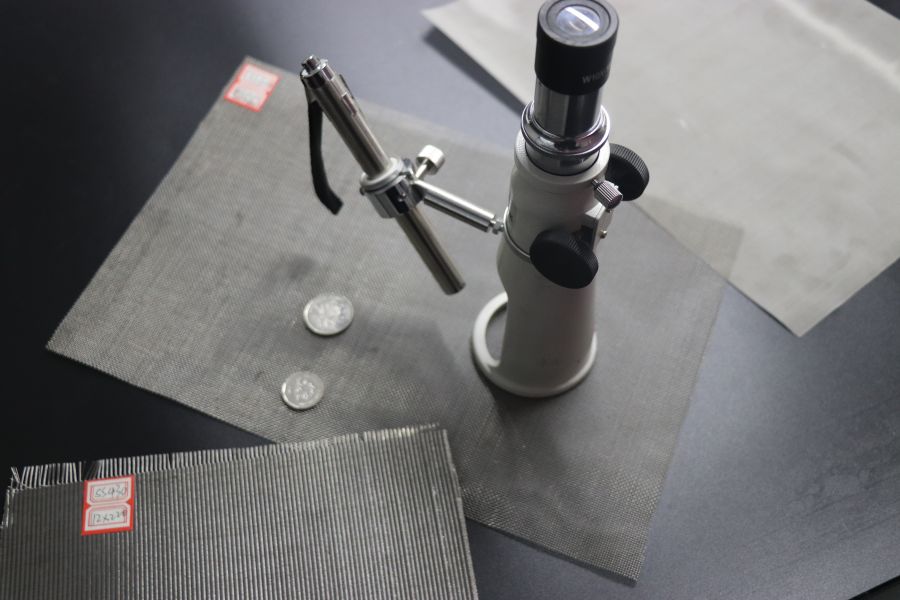
Use a simple microscope to check the uniformity of the mesh


The wire diameter refers to the thickness of a single wire in the woven mesh, and the wire gauge is also used to express this data in the wire mesh industry. In order to help customers better understand this specification, we have produced a wire gauge comparison table.
Vernier calipers or micrometer calipers are usually used to measure the wire diameter of woven wire mesh.


| Gauge (0-16) | SWG (mm) | BWG (mm) | Inches |
|---|---|---|---|
| 0 | 8.230 | 8.636 | 0.340 |
| 1 | 7.620 | 7.620 | 0.300 |
| 2 | 7.010 | 7.214 | 0.284 |
| 3 | 6.401 | 6.579 | 0.259 |
| 4 | 5.893 | 6.045 | 0.238 |
| 5 | 5.385 | 5.588 | 0.220 |
| 6 | 4.877 | 5.156 | 0.203 |
| 7 | 4.470 | 4.572 | 0.180 |
| 8 | 4.064 | 4.191 | 0.165 |
| 9 | 3.658 | 3.759 | 0.148 |
| 10 | 3.251 | 3.404 | 0.134 |
| 11 | 2.946 | 3.048 | 0.120 |
| 12 | 2.642 | 2.769 | 0.109 |
| 13 | 2.337 | 2.413 | 0.095 |
| 14 | 2.032 | 2.108 | 0.083 |
| 15 | 1.829 | 1.829 | 0.072 |
| 16 | 1.626 | 1.651 | 0.065 |
| Gauge (17-33) | SWG (mm) | BWG (mm) | Inches |
|---|---|---|---|
| 17 | 1.422 | 1.473 | 0.058 |
| 18 | 1.219 | 1.245 | 0.049 |
| 19 | 1.016 | 1.067 | 0.042 |
| 20 | 0.914 | 0.889 | 0.035 |
| 21 | 0.813 | 0.813 | 0.032 |
| 22 | 0.711 | 0.711 | 0.028 |
| 23 | 0.610 | 0.635 | 0.025 |
| 24 | 0.559 | 0.559 | 0.022 |
| 25 | 0.508 | 0.508 | 0.020 |
| 26 | 0.457 | 0.457 | 0.018 |
| 27 | 0.417 | 0.406 | 0.016 |
| 28 | 0.376 | 0.356 | 0.014 |
| 29 | 0.345 | 0.330 | 0.013 |
| 30 | 0.315 | 0.305 | 0.012 |
| 31 | 0.295 | 0.254 | 0.010 |
| 32 | 0.274 | 0.229 | 0.009 |
| 33 | 0.254 | 0.203 | 0.008 |
| Gauge (34-50) | SWG (mm) | BWG (mm) | Inches |
|---|---|---|---|
| 34 | 0.234 | 0.178 | 0.007 |
| 35 | 0.213 | 0.127 | 0.005 |
| 36 | 0.193 | 0.102 | 0.004 |
| 37 | 0.173 | * | 0.0068 |
| 38 | 0.152 | * | 0.0060 |
| 39 | 0.132 | * | 0.0052 |
| 40 | 0.122 | * | 0.0048 |
| 41 | 0.112 | * | 0.0044 |
| 42 | 0.102 | * | 0.0040 |
| 43 | 0.091 | * | 0.0036 |
| 44 | 0.081 | * | 0.0032 |
| 45 | 0.071 | * | 0.0028 |
| 46 | 0.061 | * | 0.0024 |
| 47 | 0.051 | * | 0.0020 |
| 48 | 0.041 | * | 0.0016 |
| 49 | 0.031 | * | 0.0012 |
| 50 | 0.025 | * | 0.0010 |
The reason why the woven wire mesh is widely used in different industries is inseparable from the diversified characteristics of the woven method. Due to the different weaving methods, each grid has its own characteristics. By weaving, the mesh of the wire mesh can be 5 microns invisible to the naked eye, or it can be as large as a few centimeters. Through different connection methods of warp wire and weft wire, a variety of weave patterns can be produced, which usually depends on the application requirements.
Common weaving methods:


Raw Edge is the most common machine weaving results for making woven wire mesh and can be used normally without problems in most applications.
Some customers also have special requirements for Selvage Edge. This weaving method can make the woven mesh structure more stable and not easy to deform. However, the manufacturing process is complicated and the cost is relatively high. Used for special application requirements.
Most customers choose Raw Edge.


We usually sell stainless steel woven wire mesh in rolls, and can also be cut into sheets of various sizes and shapes according to customer needs.


Are you looking for fine wire mesh? Woven wire mesh with smaller and more holes is usually called fine wire mesh. We can manufacture this and classify it into two types, fine and ultra-fine. They are often used in some demanding filtration applications.

